GPU Repair Hong Kong: BGA Reballing vs Donor Board Swap
Introduction
I've lost count of how many RTX 4090s have landed on my bench this year. Some arrive with melted 12VHPWR connectors, others with black screens and no display output at all. But the ones that really test your skills are the cards with a dead GPU core or cracked BGA solder joints. That's when you have to choose between BGA reballing and a donor board transplant.
Both are chip-level repairs. Both cost real money. And both can save a card that most shops would write off as scrap. But they're not interchangeable, and picking the wrong one wastes time and destroys a repairable PCB.
In this article I'll walk you through what each repair actually involves, which faults each one fixes, what it costs in Hong Kong, and how I decide which route to take. If you're sitting on a dead flagship card, this is the guide I wish more people read before they bin it.
重點摘要
BGA reballing fixes cracked solder joints under the GPU core and costs about HK$1,200–$1,800 with a 75–85% success rate on repairable cards. A donor board transplant replaces a dead core or PCB section and costs HK$2,000–$3,500, with higher risk and a 60–75% success rate. Both carry a 90-day ComputerKing warranty.
BGA Reballing: What It Actually Fixes and What It Costs
BGA reballing is the process of removing the GPU core from the PCB, cleaning the old solder balls off both the chip and the board pads, re-balling the chip with fresh solder, and soldering it back down. It targets one specific failure: cracked or oxidised solder joints between the GPU die package and the PCB, which typically show up as black screens, code 43 errors, or artefacts that appear only when the card warms up.
In my experience, about 40% of the dead RTX 4090s that come through my Sha Tin workshop have a reballable core. The rest have a genuinely dead die or a cracked substrate, and no amount of reflowing will bring those back. That distinction matters, because a lot of shops will happily take your money for a reball and hand back a card that still doesn't work.
Cost-wise, BGA reballing in Hong Kong runs about HK$1,200–$1,800 depending on the card and the number of BGA components involved. On a card with a large die like the AD102, the reball itself takes 3–4 hours of bench time. Turnaround is usually 2–3 working days once the card is on the bench.
The success rate I see is around 75–85% on cards that pass the pre-check. The pre-check is everything: I run a diode test on every power rail, check for substrate cracks under the microscope, and confirm the card POSTs before committing to a reball. If the core is shorted to ground on multiple rails, reballing is a waste of everyone's time.
Donor Board Transplant: When the Core or PCB Is Beyond Saving
A donor board transplant is exactly what it sounds like. When a card has a dead GPU core, a cracked PCB, or a destroyed section of the board that can't be repaired in place, I take a known-good core or board section from a donor card and transplant it onto the customer's PCB. On an RTX 4090, that usually means moving the AD102 die plus a set of VRAM chips from a donor card onto the customer's board, or moving the customer's BIOS chip and serial-numbered components onto a donor PCB.
This is the repair I reach for when reballing won't work. Typical triggers include a core that fails the substrate crack test, a PCB with a cracked trace running under the BGA array, or a card that has already been reballed once and still won't POST. I'll also go the donor route if the card has physical damage to the PCIe gold fingers or a broken corner of the PCB.
Costs run higher: HK$2,000–$3,500 depending on whether I'm sourcing the donor card and how much has to be moved. The donor card itself is usually a dead RTX 4090 bought from a scrap lot, and the good core or VRAM has to be tested before it goes anywhere near a customer's board. That testing is why the price is what it is.
Success rates sit around 60–75%, lower than a clean reball. The risk isn't the soldering, it's the unknowns: you don't know how much thermal abuse the donor core has seen, and you don't know whether the customer's PCB has hidden damage elsewhere. I turn down donor transplants on cards where the PCB has more than one cracked trace, because the repair becomes a lottery.
| Repair Type | What It Fixes | Cost (HKD) | Success Rate | Turnaround |
|---|---|---|---|---|
| BGA reballing | Cracked solder joints under GPU core | $1,200–$1,800 | 75–85% | 2–3 days |
| Donor board transplant | Dead core, cracked PCB, destroyed board section | $2,000–$3,500 | 60–75% | 4–7 days |
| VRAM replacement | Faulty GDDR6X memory chips | $800–$1,500 | 80–90% | 1–2 days |
| 12VHPWR connector rebuild | Melted power connector | $600–$1,200 | 90%+ | 1–2 days |
How I Decide: The Pre-Check That Saves Cards
Before I quote either repair, I run the same diagnostic sequence on every card. This is the part most customers never see, and it's the part that determines whether the repair is worth doing at all.
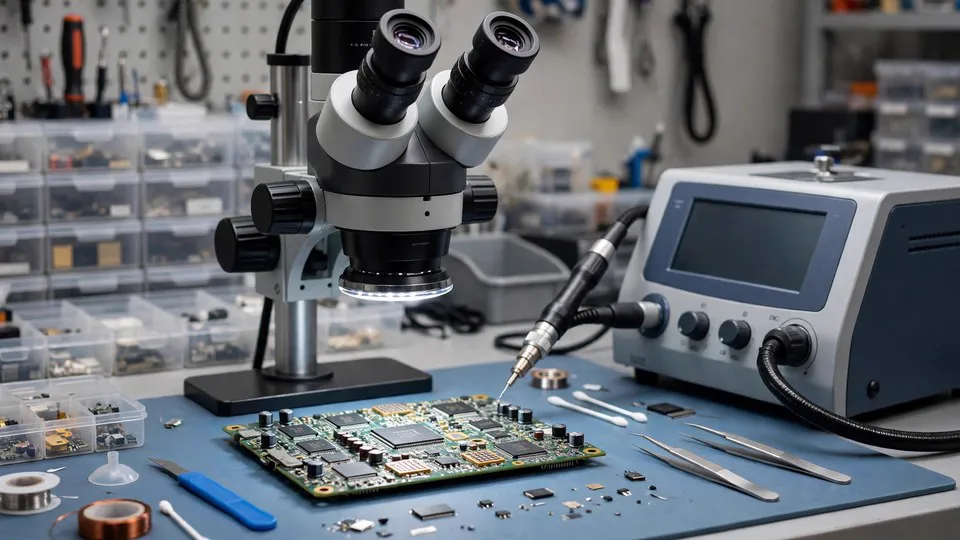
- Visual inspection under the microscope. I'm looking for substrate cracks, burn marks, corrosion from Hong Kong humidity, and signs of previous rework. A card that's been reflowed in an oven before it reached me gets extra scrutiny.
- Diode mode test on every power rail. A shorted rail tells me the core or VRM is dead before I've even powered the card up. This takes 10 minutes and saves hours.
- FLIR thermal imaging on first power-up. I want to see which components heat up abnormally. A core that stays cold while the VRM warms up is a dead core. A VRM phase that's hotter than its neighbours is a failing DrMOS.
- POST test and BIOS screen check. If the card POSTs, the core is probably alive and reballing is on the table. If it doesn't, I go straight to the donor route or decline the job.
- VRAM test with a diagnostic tool. Bad VRAM can mimic a dead core, so I test memory before committing to any BGA work. It's not unusual to find that a black-screen card just needs one memory chip replaced.
This sequence takes about 45 minutes. I don't charge for it if the customer proceeds with the repair, and I'll tell you straight if the card isn't worth saving. In my experience, about one in five RTX 4090s that arrive as "dead" are actually repairable with a cheaper fix than the customer expected.
What Hong Kong's Humidity Does to These Repairs
Hong Kong's humidity is brutal on graphics cards, and it changes how I approach BGA work. The city sits above 80% relative humidity for much of the year, and that moisture gets into every crevice of a card that's been sitting in a cupboard or a non-air-conditioned room.
When a card comes in from a damp environment, I bake it at 80°C for 12 hours before any BGA work. Skipping that step is how you get "popcorning", where trapped moisture expands during reflow and cracks the die substrate from the inside. I've seen cards come back from other shops with exactly that failure, and it's not repairable.
Oxidised contacts are the other humidity problem. Gold fingers, PCIe slot contacts, and BGA pads all corrode in damp conditions, and that corrosion adds resistance that can mimic a dead core. I've had cards where a thorough contact clean fixed a black screen that looked like a BGA fault. If your card has been sitting unused through a Hong Kong summer, get it cleaned before you assume the worst.
What the 90-Day Warranty Actually Covers
Every BGA reball and donor transplant I do at ComputerKing comes with a 90-day warranty. It covers the specific repair: if the same joint fails or the same core dies within 90 days, I'll redo the work at no charge. It does not cover new damage from a second fault, physical damage after collection, or a card that was already showing multiple faults before the repair.
The warranty qualification is straightforward. The card has to pass my post-repair stress test, which is a 2-hour loop of FurMark and a game benchmark. If it can't hold stable clocks and temperatures through that, it doesn't leave the bench. I also photograph every card before and after repair, so there's a record of its condition when it arrived.
One thing worth knowing: a repaired BGA joint is not as strong as the factory original. It's close, but it's not identical. I recommend customers run a conservative fan curve and avoid sustained thermal cycling above 80°C after a reball, because heat cycling is what kills these joints in the first place. If you're pushing an RTX 4090 at 450W for hours a day, expect the repair to have a shorter lifespan than a card that's run at stock.
Is It Worth Repairing a Dead RTX 4090?
Here's the maths I give customers. A used RTX 4090 in Hong Kong still sells for HK$8,000–$12,000 depending on condition and warranty. A BGA reball at HK$1,500 is roughly 15% of replacement cost, and a donor transplant at HK$2,800 is about 30%. If the card is otherwise sound, both are worth doing.
The calculation changes if the card has multiple faults. A card with a dead core and a melted 12VHPWR connector needs both repairs, and the combined cost can approach HK$4,000. At that point I'd rather put the money towards a replacement than sink it into a card with two major failure modes.
I also tell customers to weigh the repair against their usage. If the card is for a work machine doing AI training or 3D rendering, a repaired card with a 90-day warranty is a reasonable bridge while you source a replacement. If it's for gaming and you can wait, buying new with a full manufacturer warranty is usually the safer bet.
Frequently Asked Questions
Q: How long does a BGA reball take?
A: Bench time is 3–4 hours, but total turnaround is 2–3 working days once the card is on the bench. That includes the 12-hour bake-out, the reball itself, and a 2-hour stress test before collection.
Q: Can you reball a card that another shop already reflowed?
A: Sometimes, but the success rate drops. Oven reflows often damage the substrate or leave flux residue that causes new faults. I inspect under the microscope first and will decline the job if the substrate shows heat damage.
Q: What's the difference between reballing and reflowing?
A: Reflowing just heats the existing solder without removing the chip, which is a temporary fix at best. Reballing removes the core, cleans the pads, and installs fresh solder balls, which is the proper repair for cracked joints.
Q: Do you repair cards with cracked PCIe gold fingers?
A: Yes. Cracked traces at the gold fingers are repairable with a micro-soldering repair, usually HK$600–$1,200 depending on how many traces are damaged. It's a separate repair from BGA work and doesn't require removing the core.
Q: Can a donor board transplant change my card's serial number?
A: If the PCB is replaced, the serial number changes unless I transfer the original BIOS chip. I always discuss this with the customer before the repair, because it affects resale value and any remaining manufacturer warranty.
Conclusion
BGA reballing and donor board transplants are both legitimate ways to save a dead flagship GPU, but they solve different problems and carry different risks. Reballing is the cheaper, safer option when the core is alive and the fault is in the solder joints. A donor transplant is the last resort when the core or PCB is beyond repair, and it costs more for a reason.
The single most important step is the pre-check. A proper diagnostic sequence tells you whether the card is worth saving before anyone touches a hot air station. If you've got a dead RTX 4090, an RTX 5090 with no display, or any card that's been written off elsewhere, bring it in for an inspection. We'll tell you honestly whether it's a reball, a transplant, or a lost cause.
If you're in Hong Kong and want a straight answer on your card, WhatsApp us at +852 2186 8010 or drop by our Sha Tin workshop for an on-the-spot inspection. No obligation, no hard sell, just a diagnosis you can trust.
*This article was written by the ComputerKing senior repair team, with over 15 years of computer repair experience in Hong Kong and 10,000+ cases handled. Last updated: 2026-11-09*