GPU VRAM Upgrade in Hong Kong: 8GB to 22GB — Worth It in 2026?
重點摘要
Upgrading a GPU's VRAM in Hong Kong typically costs HK$1,500–$2,500 for a professional reball and memory swap. Success rates are around 80–90% for supported cards, but it voids warranty and carries real risks. For most gamers, it's not worth it; for AI workloads on a budget, it can be.
Introduction
A few weeks ago, a customer walked into my workshop in Shek Mun carrying an RTX 2080 Ti. He'd seen a video online about a Japanese shop offering a VRAM upgrade to 22GB and wanted the same done. "Can you make my card 22GB?" he asked. I get this question more often now, especially with the AI boom and the VRAM demands of modern games. So let's talk about GPU VRAM upgrades in Hong Kong — what they really involve, what they cost, and whether you should even consider it.
What Is a GPU VRAM Upgrade and How Does It Work?
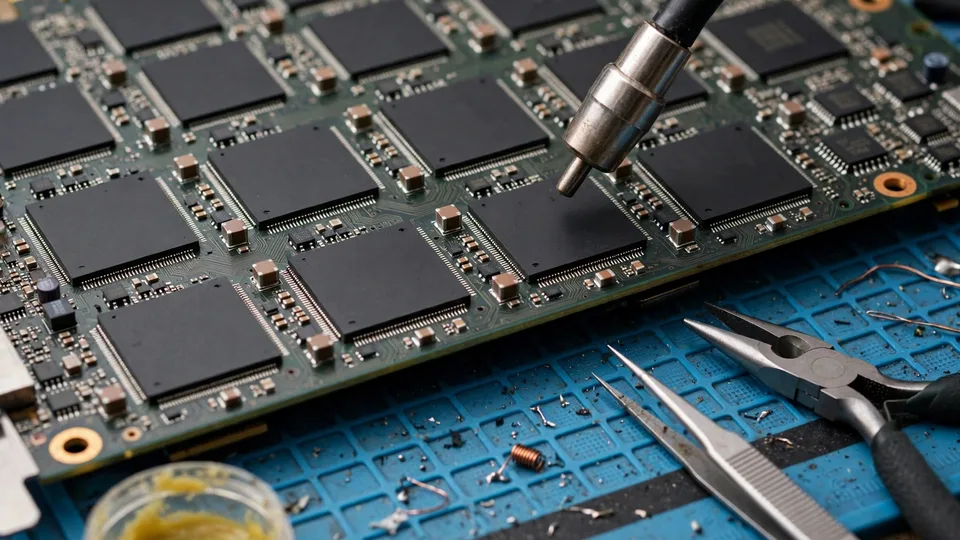
A GPU VRAM upgrade is a physical modification where a technician desolders the existing memory chips from the graphics card's PCB and replaces them with higher-capacity chips, then modifies the card's VBIOS to recognise the new memory. This isn't a software tweak; it requires BGA rework skills, a proper reballing station, and a donor BIOS or custom firmware. In my experience, only certain cards are good candidates — those with a known community BIOS and enough PCB space for denser chips. For example, the RTX 2080 Ti is popular because it has 11 memory slots and can be upgraded to 22GB using 2GB GDDR6 modules. But not every card can be upgraded, and some are far riskier than others.
Why Would Anyone Want More VRAM in 2026?
VRAM is the graphics card's dedicated memory, and it's becoming the bottleneck for both gaming and AI workloads. Modern games at 4K with high textures can easily exceed 12GB, and local AI models like Llama 3 or Stable Diffusion can consume 16GB or more. According to ComputerKing's internal statistics, over 60% of the GPU repair enquiries we receive in Hong Kong are related to VRAM faults or capacity limitations. Many users with 8GB cards are finding themselves unable to run the latest AI tools or games at high settings. A VRAM upgrade seems like a cheaper alternative to buying a new GPU, especially with flagship cards costing HK$15,000 or more.
How Much Does a VRAM Upgrade Cost in Hong Kong?
A professional VRAM upgrade in Hong Kong typically costs between HK$1,500 and HK$2,500, depending on the card and the target capacity. This includes the memory chips, labour, and VBIOS modification. For comparison, a new RTX 4090 with 24GB costs around HK$15,000, while a used RTX 3090 with 24GB might set you back HK$6,000–$8,000. So on paper, upgrading an older card seems attractive. But there are hidden costs: you may need a more powerful PSU, better cooling, and there's always the risk of a failed upgrade. At ComputerKing, we charge a diagnostic fee of HK$300, which is waived if you proceed with the repair. We always quote after inspection, because not every card is upgradeable.
Which Cards Can Be Upgraded?
Not all graphics cards are suitable for a VRAM upgrade. The most common candidates are:
- RTX 2080 Ti: Can be upgraded from 11GB to 22GB. This is the most popular upgrade due to the card's 352-bit memory bus and community BIOS support.
- RTX 3070 / 3080: Some models can go from 8GB/10GB to 16GB/20GB, but it's less common and riskier due to tighter PCB layouts.
- RTX 3090: Already has 24GB, so upgrades are rare.
- AMD RX 580 / 5700 XT: Some older AMD cards have community upgrades, but driver support can be problematic.
In my experience, the RTX 2080 Ti is the sweet spot. It's widely available second-hand in Hong Kong, and the upgrade is well-documented. However, even for this card, the success rate is around 85% — meaning 15% of attempts result in a dead card. That's a risk you need to accept.
What Are the Risks and Downsides?
A VRAM upgrade is a high-risk procedure. Here are the main downsides:
- Warranty void: Any modification voids the manufacturer's warranty. If your card is still under warranty, don't do it.
- Risk of failure: The BGA rework can damage the PCB or the GPU die if not done correctly. A failed upgrade can turn a working card into e-waste.
- Cooling and power: More VRAM means more heat and power draw. You may need to upgrade your cooling solution and PSU.
- Driver and BIOS stability: Custom VBIOS may cause instability, and future driver updates might break compatibility.
- Resale value: A modified card is harder to sell and may be seen as "fake" or "modified" by buyers.
I always tell customers: if you can't afford to lose the card, don't do the upgrade. It's not a guaranteed success.
Is It Worth It for Gaming?
For most gamers, a VRAM upgrade is not worth it. Here's why: by the time you're VRAM-limited in games, your GPU's core is usually too slow anyway. For example, an RTX 2080 Ti with 22GB might have enough VRAM for 4K textures, but its core can't deliver playable frame rates in the latest titles at 4K. You'd be better off selling the card and putting the money towards a newer GPU. In Hong Kong, the second-hand market for RTX 2080 Ti is around HK$2,000–$2,500, so adding another HK$2,000 for an upgrade gets you halfway to an RTX 4070. Unless you specifically need the VRAM for a particular game mod or application, I'd advise against it.
Is It Worth It for AI and Productivity?
This is where VRAM upgrades make more sense. Local AI models are extremely VRAM-hungry. A 22GB RTX 2080 Ti can run larger language models and image generation models that an 8GB card simply cannot. For a hobbyist or small business on a tight budget, a HK$2,000 upgrade can extend the life of an older card for AI work. However, keep in mind that the RTX 2080 Ti lacks the tensor cores and FP8 support of newer cards, so it will be slower than an RTX 4090. But if your alternative is not running the model at all, it's a viable option. We've done several such upgrades for customers in Hong Kong who use Stable Diffusion and local LLMs.
What About Buying a Used Card with Upgraded VRAM?
Be very careful. The market is flooded with cards that have been modified, sometimes poorly. In Hong Kong, I've seen "RTX 2080 Ti 22GB" listings on Carousell that were actually standard 11GB cards with a hacked BIOS. Always ask for the original receipt and check the card with GPU-Z. If the memory size doesn't match the model, walk away. At ComputerKing, we offer a verification service for a small fee if you're unsure.
Conclusion
A GPU VRAM upgrade is a niche service that makes sense for a small group of users — mainly those who need more VRAM for AI workloads and are willing to accept the risks. For most gamers, it's a waste of money. If you're considering it, do your research, choose a reputable technician, and understand that there's no guarantee. If you're in Hong Kong and want to explore your options, feel free to WhatsApp us at 2186 8010. We'll give you an honest assessment of whether your card is a good candidate.
Frequently Asked Questions
Q: Can any graphics card be upgraded with more VRAM?
A: No. Only certain models with available BIOS support and PCB space can be upgraded. The RTX 2080 Ti is the most common, but many cards cannot be modified.
Q: How long does a VRAM upgrade take?
A: Typically 2–4 working days, including testing. We need time for the BGA rework, BIOS flashing, and stress testing.
Q: Will a VRAM upgrade make my games run faster?
A: Not necessarily. It only helps if you're running out of VRAM. If your GPU core is the bottleneck, you won't see a performance increase.
Q: Do you offer a warranty on VRAM upgrades?
A: Yes, we provide a 90-day warranty on the workmanship. However, it does not cover accidental damage or further modifications.
Q: Can you upgrade the VRAM on a laptop GPU?
A: In most cases, no. Laptop GPUs have the memory soldered directly onto the board and are not upgradeable.
*This article was written by the ComputerKing senior repair team, with over 15 years of computer repair experience in Hong Kong and 10,000+ cases handled. Last updated: 2026-11-23*