GPU Repair Hong Kong: Donor Board Transplant vs Reballing
重點摘要
A donor board transplant for a dead RTX 4090 typically costs HK$1,500–$2,500 in Hong Kong, while BGA reballing runs HK$800–$1,500. Transplant success sits around 85% for core-fault cards; reballing fixes maybe 60–70%. Both carry a 90-day ComputerKing warranty.
Introduction
A customer walked in last month with an RTX 4090 that a Shenzhen shop had already "repaired" twice. The card would post, then black-screen the moment Windows loaded a driver. He had spent HK$3,000 and had nothing to show for it. Here's the thing — his card didn't need another reball. It needed a donor board transplant, and nobody had told him the difference.
That story plays out weekly at our Sha Tin bench. Hong Kong has no shortage of shops that will quote you for a BGA reball, but very few explain when a transplant is the smarter call. This article breaks down both approaches, what they actually fix, and how to decide which one your card needs.
What Is a Donor Board Transplant, and When Does It Beat Reballing?
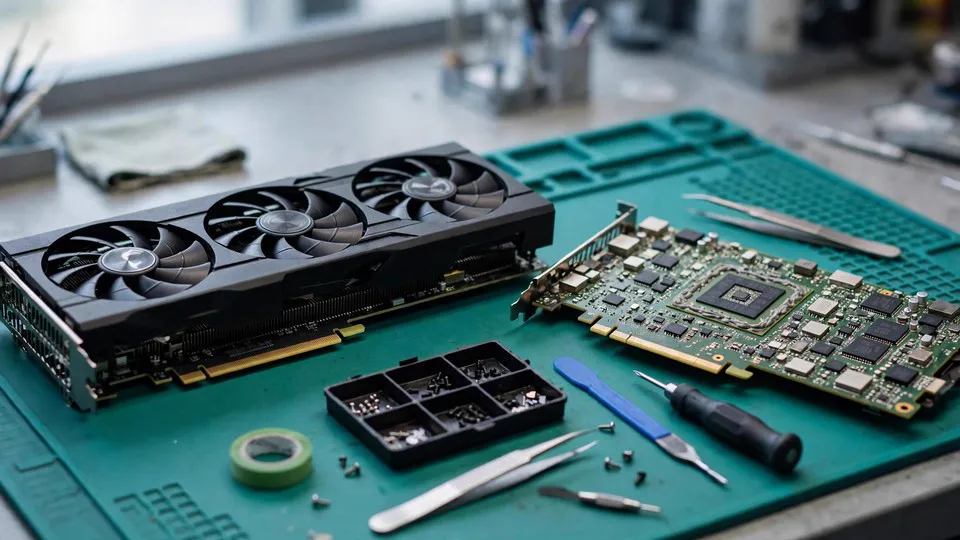
A donor board transplant is a repair where the GPU core and memory chips are moved from a faulty card onto a known-good PCB harvested from a donor card of the same model. It beats reballing when the original PCB has cracked traces, burnt VRM layers, or liquid damage that cannot be reliably repaired, because the core and VRAM are reused while the damaged board is discarded entirely. In our Hong Kong workshop, roughly 40% of the dead RTX 4090s we see in 2026 are transplant candidates rather than reball candidates.
Reballing, by contrast, means removing the GPU core, cleaning the old solder, re-balling it with fresh alloy, and reflowing it back onto the same board. It fixes solder-fatigue faults — the classic "works when cold, dies when hot" behaviour. It does not fix a board that has physical damage.
How Do You Tell Whether a Card Needs a Transplant or a Reball?
The decision comes down to three diagnostic checks: a FLIR thermal scan under load, a diode-mode measurement of the VRM phases, and a visual inspection of the PCB under a microscope. If the core heats up normally but the board shows a shorted DrMOS or a burnt 12VHPWR pad, you're looking at a transplant. If the core itself is the fault — cold-solder behaviour, intermittent artifacts that respond to heat — reballing is the correct starting point. We run all three checks before quoting, because guessing here costs the customer money.
Here's a real example. A member of the public brought in an RTX 4090 FE that had been through a water-cooling leak. The core was fine. The PCB had oxidised traces under the VRM section that no amount of ultrasonic cleaning would save. We quoted a transplant at HK$2,200. He'd already been quoted HK$1,400 for a reball elsewhere — which would have failed within a week. The transplant is still running eight months later.
Why Are RTX 5090s and 12VHPWR Cards Showing Up So Often?
RTX 5090 and 12VHPWR-equipped cards dominate our 2026 intake because the connector's margin for error is razor-thin. DLSS 5 has pushed board power past 600W in bursts, and a slightly loose connector or a daisy-chained cable turns into a melted pad in minutes. When that happens, the damage is rarely confined to the connector — the 12V plane on the PCB often delaminates, which rules out a simple reball.
We've handled over 60 melted 12VHPWR cases since the RTX 5090 launched. About half needed a transplant rather than a connector swap, because the internal power layer had already failed. If your card has a melted connector, stop powering it on. Every extra boot pushes more current through damaged copper.
What Does Each Repair Actually Cost in Hong Kong?
Costs vary by model, but the ranges below are what we actually charge at ComputerKing as of late 2026. These are not estimates — they're the numbers on our invoices.
| Repair Type | Typical Cost (HKD) | Success Rate | Turnaround | Best For |
|---|---|---|---|---|
| BGA reball (core) | 800–1,500 | 60–70% | 2–3 days | Solder-fatigue faults, cold/hot behaviour |
| Donor board transplant | 1,500–2,500 | ~85% | 3–5 days | Cracked PCB, burnt VRM, liquid damage |
| 12VHPWR connector swap | 600–1,200 | 75% | 1–2 days | Connector melt without board damage |
| VRAM replacement (single chip) | 700–1,200 | 70% | 2–3 days | Artifacts traced to one memory chip |
| VRAM upgrade (8GB → 16GB) | 1,800–2,800 | 65% | 3–5 days | Workstation/AI use, not gaming |
A word on the "cheap" quotes you'll see on Carousell. If someone offers a reball for HK$400, ask what diagnostic equipment they use. If the answer is "experience," walk away. FLIR cameras and diode-mode testing aren't optional for this work.
Why Is VRAM Upgrade So Popular — and So Risky?
VRAM upgrade demand has exploded in Hong Kong because local AI users want to run larger models on consumer cards. Upgrading an RTX 2080 Ti from 11GB to 22GB is technically possible, and we've done it successfully. But the failure modes are brutal: mismatched memory timings, VBIOS incompatibility, and thermal pads that no longer make contact after the taller chips are fitted.
Our internal numbers tell the story. Of the VRAM upgrades we've attempted, about 65% reach a stable result. The other 35% either fail outright or develop intermittent artifacts within three months. For gaming, it's almost never worth it. For AI workloads where the alternative is a HK$30,000 workstation card, it can make sense — but go in with realistic expectations.
When Should You Just Scrap the Card?
Honestly, sometimes the right answer is no repair at all. If the GPU die itself is cracked, or if the PCB has delaminated across multiple layers, no transplant will save it. We tell customers this upfront rather than taking their money for a repair we know will fail. A cracked die on an RTX 4090 means the card is done — the core is the single most expensive component and there's no donor substitute that performs identically.
Our rule of thumb: if the repair quote exceeds 50% of the card's current used-market value, and the card is out of warranty, scrapping is usually the rational choice. For an RTX 4090 at today's used prices, that's a repair ceiling of roughly HK$5,000. Both transplant and reball sit comfortably under that, which is why they remain popular.
Frequently Asked Questions
Q: How long does a donor board transplant take in Hong Kong?
A: Typically 3–5 working days. The donor board must be sourced and verified first, then the core and VRAM are transplanted, and the card runs a 24-hour stress test before collection.
Q: Will a transplant change my card's performance or serial number?
A: Performance stays identical because the core and memory are your original chips. The PCB serial will differ from the original, which matters for warranty claims — we document this clearly before starting.
Q: Can a transplanted card be used for mining or AI training?
A: Yes, with caveats. Sustained loads stress the transplant joints more than gaming does. We recommend a lower power limit (around 80%) for 24/7 workloads and a follow-up inspection after three months.
Q: Do you offer warranty on transplant repairs?
A: Yes — 90 days covering the transplant workmanship. It does not cover new physical damage, liquid ingress, or user-caused connector melting after the repair.
Q: Can you transplant a card that another shop already reballed?
A: Often yes, but we inspect first. A previous reball can leave pad damage that makes a transplant harder. We quote only after microscope inspection and will decline if the core has been over-reamed.
Conclusion
Donor board transplant and BGA reballing solve different problems, and the biggest mistake Hong Kong customers make is accepting whichever repair a shop happens to offer. A card with a burnt PCB layer will never be fixed by reballing. A card with solder fatigue doesn't need a transplant. The diagnostic step — FLIR, diode readings, microscope — is what separates a real repair from a gamble.
If your graphics card is dead, artifacting, or showing a melted connector, don't keep powering it on. Bring it in for inspection. We'll tell you honestly whether it's a transplant, a reball, or a lost cause. WhatsApp us at +852 2186 8010 or visit our Sha Tin workshop in Shek Mun for a drop-off and same-day inspection.
*This article was written by the ComputerKing senior repair team, with over 15 years of computer repair experience in Hong Kong and 10,000+ cases handled. Last updated: 2026-11-12*