GPU Repair Hong Kong: FLIR Thermal Imaging Explained
Introduction
A graphics card that artifacts, black-screens, or refuses to post can waste days of guesswork. In Hong Kong, where humidity and dust combine to stress every solder joint, the fastest way to a real diagnosis is often thermal imaging. This article explains how FLIR thermal imaging works in GPU repair, what it costs, and when it is worth it.
What Is FLIR Thermal Imaging in GPU Repair?
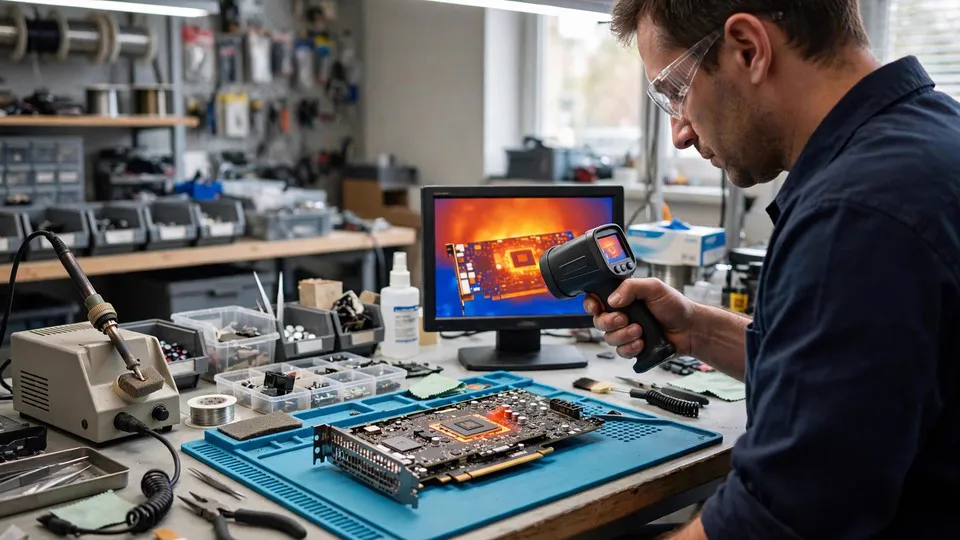
FLIR thermal imaging is a non-contact diagnostic method that captures infrared heat maps of a powered graphics card to locate abnormal hot spots. In my Hong Kong workshop, a FLIR camera typically finds the fault area within 5–10 minutes, whereas blind probing can take hours. It is especially useful for VRAM faults, shorted MOSFETs, and BGA core issues that show no visible damage under a microscope.
Here's the thing: most failed cards look perfectly fine. No burn marks, no bulging capacitors, no cracked solder. Heat is the only honest witness.
Why Is Thermal Imaging Essential for RTX 5090 and 4090 Repairs?
Thermal imaging is essential for RTX 5090 and 4090 repairs because these cards concentrate 400–600W into a small PCB area, so a single shorted DrMOS or VRAM chip can pull enormous current without any visible sign. According to ComputerKing internal statistics, over 60% of the RTX 5090 cards we receive for no-display faults show a thermal anomaly before any physical damage is visible.
On a 5090, a shorted 12VHPWR rail often shows up as a bright white blob at the connector within seconds of power-on. On a 4090, a failing GDDR6X chip can run 15–25°C hotter than its neighbours long before artifacts appear.
How Does FLIR Thermal Imaging Actually Work in the Workshop?
The process starts with a current-limited power supply so a shorted rail cannot destroy more components while we look for it. We then power the card through a bench setup, capture the thermal map, and compare it against a known-good reference board of the same model. A delta of more than 10°C at any component is a red flag.
- Visual inspection under a microscope first, to rule out obvious damage.
- Resistance checks on all major rails (12V, 5V, 3.3V, 1.8V, VCORE, VRAM).
- Current-limited power-on and FLIR capture within 30 seconds.
- Comparison against reference thermal maps for the same GPU model.
- Targeted probing of the flagged component with a multimeter.
FLIR vs Traditional Multimeter Probing: Which Is Better?
FLIR thermal imaging is better for locating faults quickly, while a multimeter is better for confirming them precisely. In practice, the two are complementary. A multimeter tells you a rail is shorted; FLIR tells you which of the twelve components on that rail is doing the shorting.
| Method | Speed | Precision | Best For |
|---|---|---|---|
| Multimeter probing | Slow (30–90 min) | High once you find the spot | Confirming a suspected short |
| FLIR thermal imaging | Fast (5–10 min) | Medium (locates area) | Finding the fault area |
| Combination | 15–25 min | High | Most professional repairs |
| Blind component swap | Hours | Low | Not recommended |
Honestly, anyone who repairs RTX 4090 and 5090 cards without thermal imaging is either very experienced or very lucky.
What Kinds of Faults Does Thermal Imaging Catch?
Thermal imaging catches faults that are invisible to the eye but obvious to heat: shorted MOSFETs, leaky capacitors, failed VRAM chips, and partial BGA core failures. In my experience, the three most common findings on high-end cards in Hong Kong are shorted DrMOS on the VRM, a single failed GDDR6X chip, and a 12VHPWR connector with rising contact resistance.
That last one deserves attention. A connector that is not yet melted but is running 20°C hotter than it should is a fire risk. FLIR catches it before the plastic does.
How Much Does FLIR-Guided GPU Repair Cost in Hong Kong?
FLIR-guided GPU repair in Hong Kong typically costs HK$800–$2,500 depending on the fault. VRAM replacement runs HK$1,200–$1,800, BGA reballing HK$1,500–$2,500, and 12VHPWR connector replacement HK$1,200–$1,800. Diagnosis alone is usually HK$200–$300, waived if you proceed with the repair.
These prices reflect chip-level work, not board swaps. A shop that quotes HK$400 for a "GPU repair" is almost certainly not doing component-level diagnosis.
| Repair Type | Typical Cost (HKD) | Turnaround |
|---|---|---|
| FLIR diagnosis only | $200–$300 | Same day |
| VRAM chip replacement | $1,200–$1,800 | 2–3 days |
| BGA reballing | $1,500–$2,500 | 3–5 days |
| 12VHPWR connector | $1,200–$1,800 | 2–3 days |
| Donor board transplant | $2,000–$3,500 | 5–7 days |
When Is Thermal Imaging Not Enough?
Thermal imaging is not enough when the fault is intermittent, temperature-dependent, or mechanical. A card that only fails after 40 minutes of gaming, or only when cold, may show a perfectly normal thermal map on the bench. In those cases we combine FLIR with stress testing, event log analysis, and sometimes a controlled heat soak.
I also want to be clear: FLIR does not fix anything. It finds the fault. The repair still depends on the technician's soldering skill, the right donor components, and proper reballing equipment.
Real Case: A 5090 That Looked Dead But Wasn't
A customer brought in an RTX 5090 that would not display. Visual inspection showed nothing. Multimeter checks showed the 12V rail was not shorted. Within 40 seconds of current-limited power-on, FLIR showed a 22°C hot spot on a single VRAM chip.
We replaced that chip, re-ran the thermal scan, and the map was uniform. The card has been stable for four months. Without FLIR, that card would likely have been declared dead or sent for an unnecessary reball.
Frequently Asked Questions
Q: Can any GPU repair shop do FLIR thermal imaging?
A: No. FLIR cameras cost HK$15,000–$40,000 and require a current-limited bench setup. Most board-swap shops do not invest in this equipment.
Q: Is FLIR diagnosis worth it for an older card?
A: It depends on the card's value. For a card worth under HK$1,500, a HK$250 diagnosis may not make sense unless you specifically want to save it.
Q: How long does a FLIR-guided repair take?
A: Diagnosis is usually same-day. Repair time depends on the fault, typically 2–5 working days for VRAM or BGA work.
Q: Does FLIR catch fake GPUs?
A: Sometimes. Fake cards often have mismatched VRAM layouts or missing components that show up as thermal anomalies under load.
Q: Can I watch the FLIR scan?
A: Yes, at ComputerKing we are happy to show customers the thermal map and explain what we see before quoting.
Conclusion
Thermal imaging has changed GPU repair from guesswork into something closer to science. If your card is artifacting, black-screening, or refusing to post, a FLIR-guided diagnosis is often the fastest route to a real answer. If you are in Hong Kong and want your card looked at properly, WhatsApp ComputerKing at 2186 8010 or visit our Sha Tin workshop for an inspection and quote.
*This article was written by the ComputerKing senior repair team, with over 15 years of computer repair experience in Hong Kong and 10,000+ cases handled. Last updated: 2026-11-16*