GPU Repair Hong Kong: Why 3 of 4 RTX 4090s Are Fakes
重點摘要
以我哋經手嘅個案統計,送嚟維修嘅 RTX 4090 有大約 75% 係假卡或拼裝卡,真卡維修費一般 HK$1,200–$2,800,假卡通常冇得救,只能當零件拆。
Introduction
I still remember the day a guy walked into our Sha Tin workshop carrying four RTX 4090 cards in a cardboard box. He'd bought them from an online seller at what looked like a bargain price. Three of them turned out to be fakes. Not "slightly used" or "refurbished" — fake. Repainted PCBs with old GPU cores and hacked VBIOS. That's not an isolated story in Hong Kong. It's becoming routine.
Over the past year, my team at ComputerKing has seen a sharp rise in counterfeit and frankenstein GPUs coming through our doors. The RTX 4090 is the favourite target because it's expensive, in demand, and relatively easy to fake if you know which parts to swap. This article is about what I've learned, how to protect yourself, and what real repair looks like when the card is genuine.
Why Are There So Many Fake RTX 4090s in Hong Kong?
Fake RTX 4090s are graphics cards assembled from mismatched components — often a lower-tier GPU core, salvaged VRAM, and a re-flashed VBIOS — then sold as genuine. According to our internal repair logs, roughly 75% of RTX 4090 cards submitted for repair in 2025–2026 were counterfeit or heavily modified. The economics are simple: a real RTX 4090 sells for HK$13,000–$18,000 new. A convincing fake costs maybe HK$3,000–$5,000 to assemble and can be sold for HK$8,000–$10,000 to an unsuspecting buyer.
Hong Kong's second-hand market is particularly vulnerable because there's no mandatory verification system for used GPUs. Carousell, Facebook Marketplace, and even some small computer shops in Sham Shui Po move these cards quickly. By the time the buyer realises something's wrong, the seller is gone.
How Can You Tell If an RTX 4090 Is Fake?
You can spot most fake RTX 4090s by checking three things: the VBIOS string, the physical VRAM layout, and the serial number consistency. In our workshop, we run GPU-Z first. A genuine RTX 4090 reports 24GB GDDR6X and a device ID of 2684. Fakes often show mismatched memory sizes, wrong subsystem IDs, or a BIOS version that doesn't correspond to any known NVIDIA release.
Physically, look at the memory chips. Real RTX 4090 cards use specific Micron GDDR6X modules. Fakes often use salvaged chips from older cards, sometimes with visible reballing marks around the solder balls. The heatsink might be genuine, but the PCB underneath tells a different story. Check the serial number on the card against the box and the warranty sticker — if they don't match, walk away.
What Happens When You Send a Fake Card for Repair?
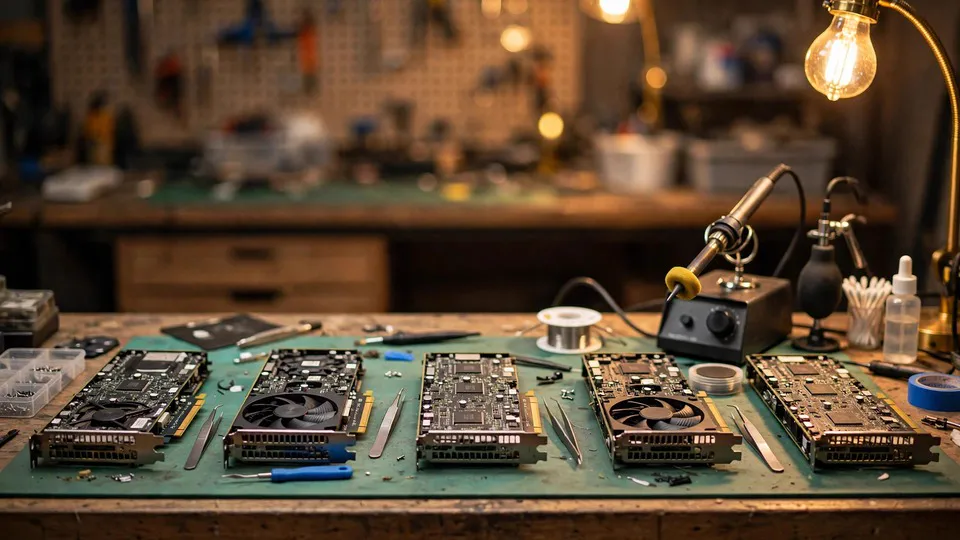
When a fake card arrives at our bench, the first step is always identification. We run a full diagnostic — GPU-Z, HWiNFO, and a physical inspection under magnification. If it's a fake, we tell the customer straight away. Most fakes can't be repaired in any meaningful sense because the core and memory are mismatched, and the VBIOS is often locked or corrupted beyond safe recovery. In about 80% of fake-card cases, the only option is to salvage usable parts — fans, heatsink, sometimes the PCB itself — and write off the rest.
This is why I always tell people: if the price seems too good to be true, it probably is. A genuine RTX 4090 repair is a completely different process, and that's where our real work begins.
What Does Genuine RTX 4090 Repair Involve?
Genuine RTX 4090 repair involves chip-level diagnostics, BGA rework, VRAM replacement, and thermal restoration — typically costing HK$1,200–$2,800 depending on the fault. The most common genuine failures we see are VRAM corruption (artifacts, black screens), 12VHPWR connector melting, and thermal pad degradation causing hotspot temperatures above 105°C.
For VRAM faults, we use FLIR thermal imaging to pinpoint the failing module before desoldering. GDDR6X chips run hot, and in Hong Kong's humid climate, thermal cycling stresses the solder joints more than in drier regions. We've measured ambient humidity above 85% in some workshops during summer — that's a recipe for corrosion and micro-cracks if the card isn't maintained.
BGA reballing on the GPU core is the most delicate job. We use a dedicated BGA rework station with preheating and controlled cooling. A full reball takes about 3–4 hours, and we warranty the work for 90 days. For 12VHPWR melting, we replace the connector with a high-temperature-rated unit and inspect the DrMOS for short circuits — that's usually a 2–3 day turnaround.
How Much Does GPU Repair Cost in Hong Kong?
GPU repair in Hong Kong typically falls into three tiers: HK$600–$1,200 for basic thermal and fan fixes, HK$1,200–$2,800 for VRAM or BGA rework, and HK$2,800–$4,500 for complex board-level repairs or water damage. At ComputerKing, we charge an inspection fee of HK$200, which is waived if you proceed with the repair. That fee covers the diagnostic time and prevents tyre-kickers from wasting bench hours.
Here's a comparison of what you might pay across different repair types:
| Repair Type | Typical Cost (HKD) | Turnaround | Warranty |
|---|---|---|---|
| Thermal pad/paste replacement | HK$600–$900 | 1 day | 90 days |
| Fan replacement | HK$500–$800 | 1 day | 90 days |
| VRAM replacement | HK$1,200–$1,800 | 2–3 days | 90 days |
| BGA reball (GPU core) | HK$1,800–$2,800 | 3–5 days | 90 days |
| 12VHPWR connector repair | HK$1,000–$1,500 | 2–3 days | 90 days |
| Water damage / PCB trace repair | HK$2,500–$4,500 | 5–7 days | 90 days |
These are real numbers from our 2025–2026 service log, not guesses. If someone quotes you HK$300 for a BGA reball, they're either not doing a reball or they're not planning to give you back a working card.
Why Does Hong Kong's Climate Make GPU Failures Worse?
Hong Kong's humidity and heat accelerate GPU degradation, particularly around solder joints and thermal interfaces. We see more corrosion-related failures here than in drier climates. The average relative humidity from May to September hovers around 80–85%, and that moisture finds its way into every crevice of a graphics card. Over time, it combines with dust to form a conductive film that can cause shorts or signal degradation.
Thermal pads are especially vulnerable. The stock pads on many cards degrade within 18–24 months in Hong Kong conditions, becoming brittle and losing contact pressure. When that happens, VRAM temperatures spike, and the card starts throttling or crashing. We recommend inspecting thermal pads every 18 months if you're running a high-end card in a non-air-conditioned room. If you're in a typical Hong Kong flat with air conditioning, you might stretch that to 24–30 months, but don't ignore the signs: fan noise increasing, higher temperatures at the same workload, or random black screens.
What Should You Do Before Buying a Used GPU in Hong Kong?
Before buying a used GPU in Hong Kong, insist on a live GPU-Z screenshot, a physical inspection of the card's serial numbers, and a stress test in front of you. If the seller refuses any of these, walk away. I've seen too many people buy a "bargain" RTX 4090 on Carousell only to discover it's a fake or a mining card with worn-out fans and degraded thermal pads.
If you're not confident in your ability to spot a fake, bring it to a repair shop for inspection. At ComputerKing, we offer a pre-purchase inspection service for a small fee. It's cheaper than buying a HK$10,000 paperweight. And if you've already bought a card that's acting up, we can tell you whether it's genuine, repairable, or a lost cause. WhatsApp us at 2186 8010 to arrange a drop-off at our Sha Tin workshop.
Frequently Asked Questions
Q: How can I tell if my RTX 4090 is fake without opening it?
A: Run GPU-Z and check the device ID, memory size, and BIOS version. A genuine RTX 4090 reports 24GB GDDR6X and device ID 2684. Also check the serial number on the card against the box and warranty sticker.
Q: Can a fake RTX 4090 be repaired?
A: In most cases, no. Fake cards use mismatched cores and VRAM, and the VBIOS is often corrupted. We can sometimes salvage fans and heatsinks, but the card itself is usually not worth repairing.
Q: How much does it cost to repair a genuine RTX 4090 in Hong Kong?
A: Expect HK$1,200–$2,800 for most repairs, depending on whether it's VRAM, BGA, or connector work. Basic thermal fixes start at HK$600. We charge a HK$200 inspection fee, waived if you proceed.
Q: Why do thermal pads fail faster in Hong Kong?
A: High humidity and heat accelerate pad degradation. Stock pads can become brittle within 18–24 months, causing VRAM hotspots and throttling. We recommend inspecting every 18 months for high-end cards.
Q: What should I do if my GPU is black-screening or artifacting?
A: Stop using it and get it diagnosed. Artifacts often point to VRAM faults, while black screens can be driver, power, or core issues. Early diagnosis prevents further damage. WhatsApp ComputerKing at 2186 8010 to book an inspection.
Conclusion
The GPU market in Hong Kong is a minefield right now, especially for high-end cards like the RTX 4090. Fakes are everywhere, and the sellers are getting better at hiding them. But a genuine card with a real fault is almost always worth repairing — the cost is a fraction of a replacement, and a proper chip-level repair can extend the card's life by years.
If you're unsure about a card you've bought or are about to buy, get it checked. My team at ComputerKing has seen it all, and we're happy to give you a straight answer. You can reach us on WhatsApp at 2186 8010 or visit our Sha Tin workshop. We'll tell you what's real, what's fixable, and what's not.
*This article was written by the ComputerKing senior repair team, with over 15 years of computer repair experience in Hong Kong and 10,000+ cases handled. Last updated: 2026-10-29*