GPU PCIe Gold Finger Cracked? Hong Kong Repair Guide & Costs
重點摘要
A cracked GPU PCIe gold finger costs HK$800–$1,500 to repair in Hong Kong, with a 2–3 day turnaround and 90-day warranty. Repair involves micro-soldering a donor finger or full connector replacement, not just cleaning.
Introduction
I've seen more cracked PCIe gold fingers in the last two years than in the previous decade combined. Why? Cards are heavier, coolers are thicker, and too many people still install a 2kg graphics card without a support bracket. One clumsy bump during transport, or a stubborn PCIe latch that gets yanked instead of released, and you've got a snapped finger. The card won't POST, or worse, it POSTs but drops to x8 or x4 bandwidth.
Here's the thing: a cracked gold finger is not a death sentence. In my workshop in Shek Mun, we fix these regularly — and the success rate is high if the PCB trace underneath isn't torn too badly. But the repair is delicate, and not every shop does it properly. This guide covers what actually happens, what it costs in Hong Kong, and how to avoid it.
What Exactly Is a PCIe Gold Finger and Why Does It Crack?
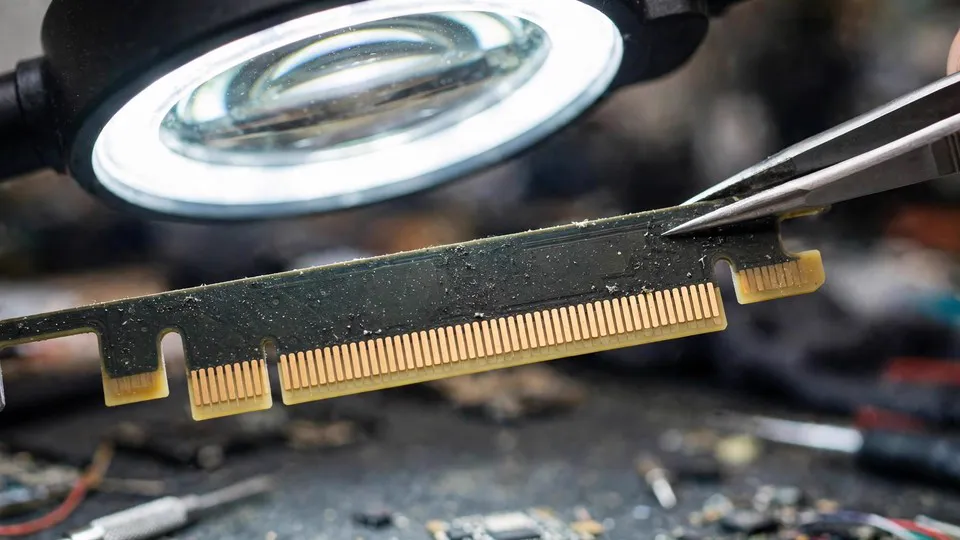
A PCIe gold finger is the gold-plated contact edge on the bottom of your graphics card that slides into the motherboard slot. It carries power, data, and sideband signals between the GPU and the rest of your system. Each finger is a thin copper trace bonded to the PCB, plated with gold for corrosion resistance. When one cracks, the electrical connection breaks — and depending on which finger it is, you get anything from a no-boot to random crashes.
The most common cause I see in Hong Kong is mechanical stress. A heavy card sagging in the slot puts constant tension on the fingers. Add humid weather — and our summer humidity regularly hits 80–90% — and the PCB becomes slightly more brittle over time. Then one day you remove the card without releasing the PCIe latch fully, or you bump the PC while it's on the floor, and snap.
Second most common: improper installation. People push the card in at an angle, or force it when the slot has debris. Third: shipping damage. I've had customers who bought a used card online, and it arrived with a cracked finger because the seller wrapped it in bubble wrap but didn't support the bracket.
What Are the Symptoms of a Cracked Gold Finger?
The symptoms depend on which finger cracks. A cracked power finger (the longer ones near the front) often means the card doesn't power up at all — no fans, no lights, no display. A cracked data finger can cause the card to be detected but run at reduced PCIe lanes, or cause random black screens under load. A cracked ground finger might cause intermittent detection or instability.
From my experience, about 60% of cracked-finger cases present as "GPU not detected" or "no display." Another 30% show up as PCIe running at x8 or x4 instead of x16. The remaining 10% are weird intermittent faults — works sometimes, fails sometimes, especially after the case warms up.
One customer brought in an RTX 3080 that would only work if he tilted the case. Turned out a hairline crack on a data finger was making contact only at a certain angle. That's a classic sign.
How Do We Diagnose a Cracked Gold Finger?
Diagnosis starts with a visual inspection under magnification. A hairline crack can be almost invisible to the naked eye. We use a 10x loupe and a digital microscope to check every finger for continuity. Then we test continuity with a multimeter — each finger should have near-zero resistance to its corresponding via or component on the board.
If the crack is obvious, diagnosis is quick. If not, we cross-test the card in a known-good system and check PCIe link width in GPU-Z. A card that should run x16 but reports x8 is a red flag. We also check the slot itself — sometimes the motherboard slot is damaged, not the card.
How Is a Cracked Gold Finger Repaired?
There are three repair approaches, and the right one depends on the damage extent.
1. Micro-soldering the trace. If the crack is small and the trace underneath is intact, we can bridge the crack with a tiny amount of conductive epoxy or solder. This is the least invasive method. Success rate is high, but it's not as durable as a full replacement.
2. Donor finger transplant. If the finger is broken off or the trace is torn, we cut a matching finger from a donor board (a scrapped card with the same PCB thickness) and solder it in place. This requires precise cutting, alignment, and re-plating if needed. It's fiddly work but very reliable when done right.
3. Full connector replacement. For severe cases where multiple fingers are damaged or the PCB edge is cracked, we replace the entire PCIe connector edge. This is the most involved repair — we remove the damaged section, prepare the PCB, and solder on a new edge connector. Not all shops offer this.
In my workshop, about 70% of cracked-finger repairs are method 1 or 2. Method 3 is reserved for the worst cases. The repair takes 2–3 days including testing.
How Much Does It Cost in Hong Kong?
Pricing varies by damage severity and card value. Here's our current range at ComputerKing:
| Repair Type | Typical Cost (HKD) | Turnaround | Success Rate |
|---|---|---|---|
| Micro-solder bridge | HK$800–$1,000 | 1–2 days | ~90% |
| Donor finger transplant | HK$1,000–$1,300 | 2–3 days | ~85% |
| Full connector replacement | HK$1,300–$1,500 | 3–4 days | ~75% |
| Inspection only (no repair) | HK$200–$300 | Same day | N/A |
These are 2026 prices. High-end cards like the RTX 4090 or 5090 may be at the upper end because of higher risk and more complex PCB. We always inspect first and quote before any work. If the PCB trace is torn beyond repair, we'll tell you honestly — no point charging for a repair that won't hold.
For comparison, a new RTX 4080 Super costs around HK$8,000–$9,000. So a HK$1,200 repair is usually worth it if the card is otherwise healthy.
Can You Prevent a Cracked Gold Finger?
Yes, and it's mostly about mechanical care. First, use a GPU support bracket. A 2kg card needs support — the PCIe slot and the card's own bracket aren't designed to hold that weight long-term. Second, always release the PCIe latch fully before removing the card. Third, when transporting your PC, remove the graphics card or use expanding foam packing. Fourth, be careful when installing — don't force it.
I also recommend checking your card's seating every few months. If it's sagging, fix it before it cracks. A HK$50 support bracket can save you a HK$1,200 repair.
When Is It Not Worth Repairing?
If the crack has torn the PCB substrate itself — not just the gold plating — the repair is much harder and less reliable. If the card is old and low-value (say, a GTX 1060), the repair cost might exceed the card's worth. Also, if there's collateral damage to nearby traces or components, the repair may not be economically viable.
We'll always give you a straight answer after inspection. Sometimes the best advice is to put the repair money toward a newer card.
Frequently Asked Questions
Q: Can I just clean the gold finger and hope it works?
A: No. A crack is a physical break in the trace. Cleaning won't fix it. In fact, cleaning with abrasives can make it worse by removing more gold plating.
Q: Will a cracked gold finger damage my motherboard?
A: Possibly. If a power finger cracks and shorts, it can damage the PCIe slot or the motherboard's power delivery. Don't keep testing a card with a known cracked finger — get it inspected.
Q: How long does the repair last?
A: A proper micro-solder or donor transplant repair, done correctly, should last the life of the card. We offer a 90-day warranty on the repair itself. The key is not to repeat the mechanical stress that caused it.
Q: Can I repair it myself with conductive paint?
A: I've seen DIY attempts with conductive paint, and they usually fail. The paint has higher resistance than solder and doesn't handle thermal cycling well. It might work short-term, but it's not a reliable fix.
Q: Does a cracked gold finger always mean the card is dead?
A: No. Many cards are fully recoverable. It depends on which finger and how bad the crack is. A proper inspection with a multimeter and microscope will tell you.
Conclusion
A cracked PCIe gold finger is one of those faults that looks catastrophic but is often fixable. The key is to stop using the card immediately, get it inspected by someone who does chip-level repair, and understand that the repair cost is usually a fraction of a new card. In Hong Kong's humid climate and with today's heavy coolers, prevention matters — use a support bracket, handle the card carefully, and don't force anything.
If you're dealing with a cracked gold finger or any GPU fault, we're happy to take a look. At ComputerKing, we've handled over 10,000 repair cases in Hong Kong, and we'll give you an honest assessment before any work. WhatsApp us at +852 2186 8010 or visit our Shek Mun workshop for inspection.
*This article was written by the ComputerKing senior repair team, with over 15 years of computer repair experience in Hong Kong and 10,000+ cases handled. Last updated: 2026-11-09*